Quick Links: About Us - Contact Us
For bookings, call us at
+501 677-2900
Quick Links: About Us - Contact Us

Quick Links: About Us - Contact Us

April is arguably the most dynamic month in Belize’s birdwatching calendar. Resident species are in full breeding plumage—brighter, more vocal, and more visible than at any other time of year. Late-season migratory species are still present before departing for their North American nesting grounds, swelling the species count at key birding sites to remarkable levels. For the traveling birdwatcher, April in Belize represents a genuinely exceptional window.
Three things converge to make April extraordinary for birdwatchers. First, breeding season is in full swing for resident species, which means males are singing loudly and displaying conspicuously to attract mates—dramatically increasing the chances of detecting and observing species that are secretive in other months. Second, spring migration is still underway, with neotropical migrant warblers, tanagers, orioles, and shorebirds moving through Belize on their way from their Central and South American wintering grounds to breeding sites in North America. Third, the early rains begin greening up the landscape, concentrating waterbirds at lagoons and wetlands in spectacular numbers as water levels slowly rise.
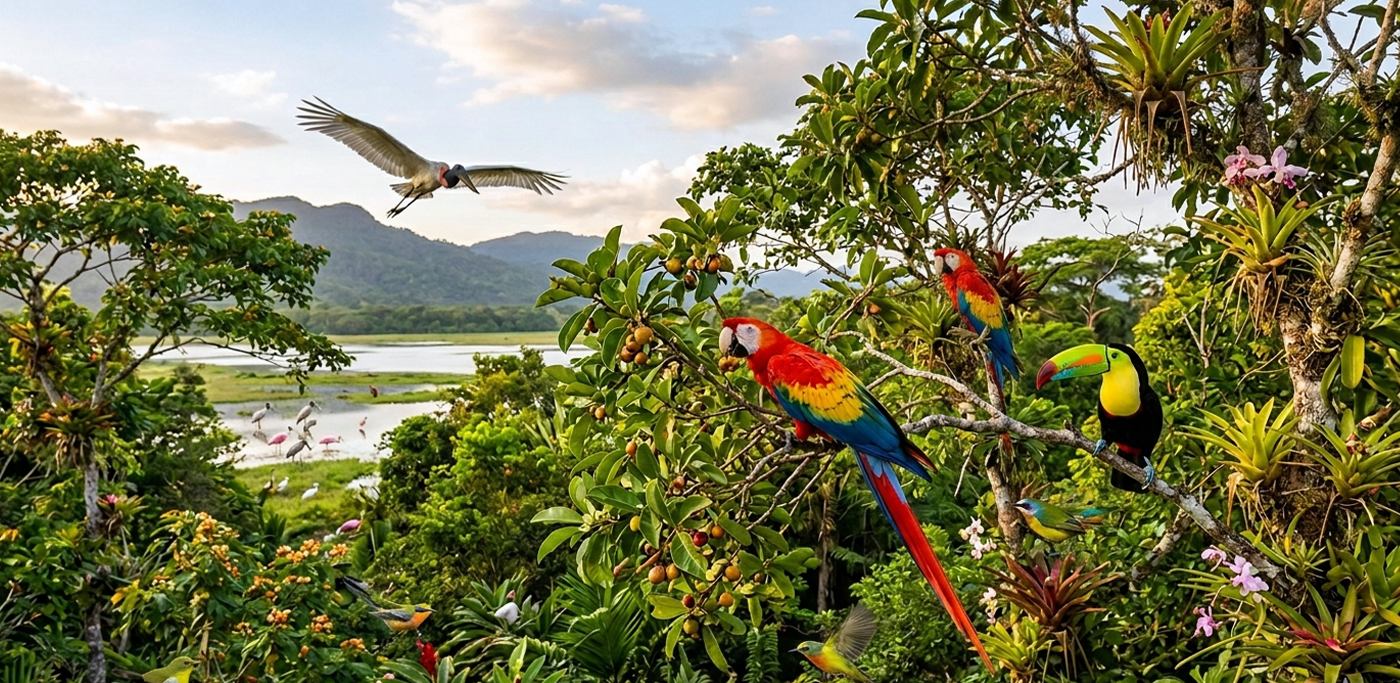
The Scarlet Macaw (Ara macao) is Belize’s most charismatic resident bird, and April is the tail end of their peak viewing season at Red Bank Village in the Stann Creek District. These magnificent birds—up to 90cm long with brilliant red, yellow, and blue plumage—roost in ramon and cohune trees in jaw-dropping congregations. Local community guides at Red Bank organize morning and late-afternoon viewing walks for approximately BZD 20–30 per person, making this one of the most affordable and spectacular wildlife experiences in all of Belize.
The Jabiru Stork (Jabiru mycteria), the Western Hemisphere’s largest flying bird with a wingspan reaching 2.4 meters, is a Crooked Tree Wildlife Sanctuary specialty. April’s rising water levels concentrate these magnificent birds at the lagoon’s edge, where they stalk fish and frogs with prehistoric dignity. Early morning boat tours at Crooked Tree regularly produce multiple Jabiru sightings alongside Roseate Spoonbills, Snail Kites, and Black-collared Hawks.
The Keel-billed Toucan (Ramphastos sulfuratus)—Belize’s national bird—is highly vocal in April breeding season and conspicuous at forest-edge habitats throughout the country. Their outrageous rainbow bills and raucous calls make them impossible to miss and impossible not to love. Chaa Creek and Chan Chich Lodge report daily multiple sightings in April.
The Resplendent Quetzal (Pharomachrus mocinno), while more associated with Guatemala’s highland cloud forests, does occur in Belize’s Mountain Pine Ridge and Victoria Peak area. April sightings are rare but documented, and any birdwatcher who ticks this spectacularly beautiful species in Belize has truly struck gold.
Spring warblers are perhaps April’s most exciting category for visiting North American birdwatchers. Up to 40 warbler species pass through or remain in Belize in April, including Bay-breasted Warbler, Blackpoll Warbler, and the gorgeous Golden-winged Warbler—species that are increasingly difficult to find in their northern range but still abundant in Belize’s mature forest.
Crooked Tree Wildlife Sanctuary (Northern Belize) is essential for waterbirds. The lagoon system at peak water concentration supports thousands of migratory shorebirds and breeding waterbirds simultaneously. Hire local guide Sam Tillett or another registered Crooked Tree guide for the most productive experience.
Chan Chich Lodge (Northwestern Belize) sits within a 130,000-acre private nature reserve that protects some of Belize’s most intact broadleaf forest. The lodge’s bird list exceeds 350 species, and April morning walks on the property’s private trail network are among the finest forest birding experiences in Central America.
Cockscomb Basin Wildlife Sanctuary (Stann Creek District) is outstanding for forest interior species including Scarlet-rumped Tanager, Trogons, and elusive antbirds. The sanctuary’s well-maintained trail network makes it accessible for independent birdwatchers with a field guide.
Community Baboon Sanctuary (Northern Belize) is named for the howler monkey but is equally excellent for forest-edge birding, with reliable sightings of Vermilion Flycatcher, White-collared Seedeater, and multiple kingfisher species along the Belize River.
Belizean birding guides are among the most knowledgeable and passionate natural history interpreters in Central America. The Belize Birding Directory (available through the Belize Tourism Board) lists accredited guides by region. Tour operators including Chaa Creek, Lamanai Outpost Lodge, and Chan Chich offer dedicated birding packages with expert naturalist guides. Day rates for private birding guides typically run USD 80–150 per person including transport.